
The Ultimate Guide to the IOE Engineering Entrance Examination in Nepal
Planning to take the IOE Engineering Entrance Exam in Nepal? Discover the complete step-by-step guide covering eligibility criteria, mark distribution, online registration, and counseling tips to secure your seat at Pulchowk or other top constituent campuses.
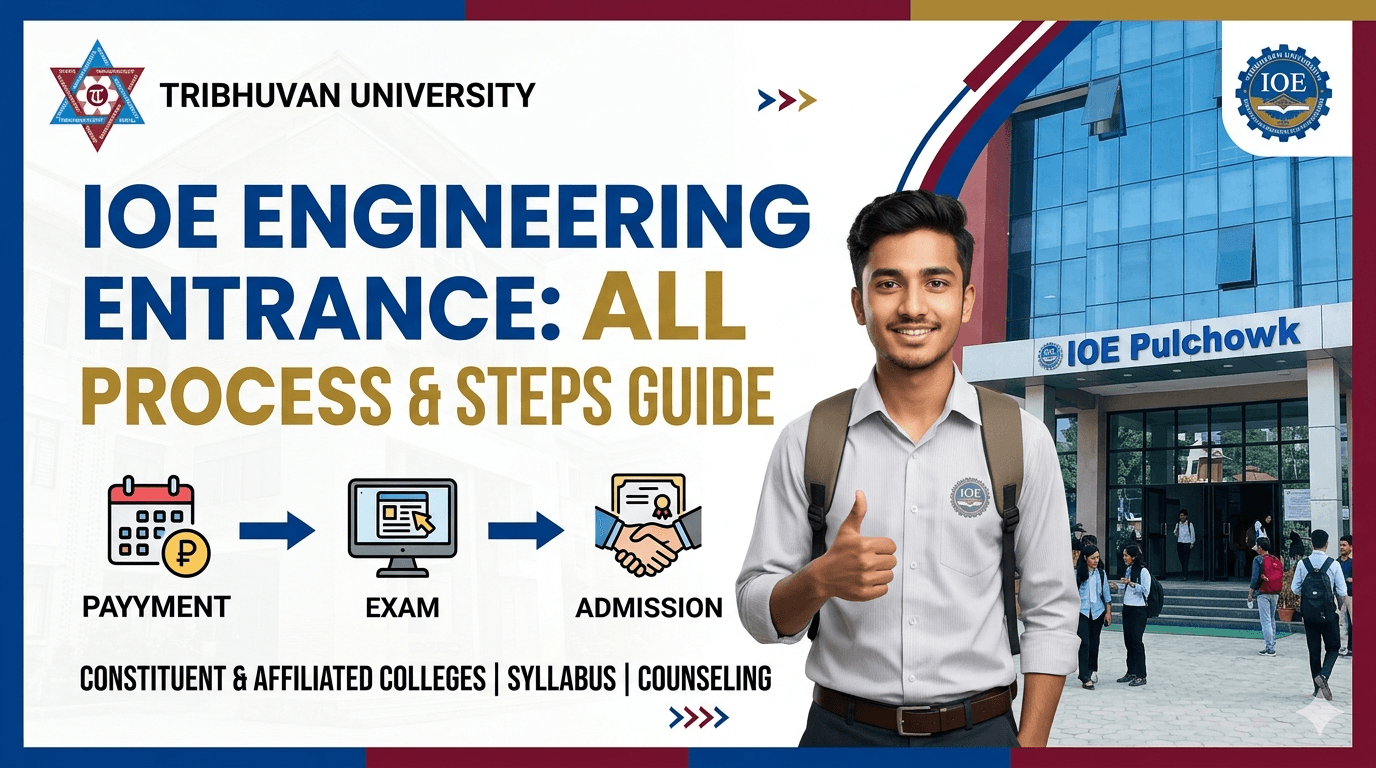
For science students in Nepal, engineering is one of the most sought-after and prestigious career paths. At the center of this ambition is the Institute of Engineering (IOE) under Tribhuvan University (TU). Known for producing world-class engineers, researchers, and tech leaders, getting into an IOE constituent campus is a highly competitive milestone.
Every year, 10,000 to 15,000 students compete for a limited number of seats. If you are planning to crack the IOE entrance exam, this comprehensive guide covers everything from eligibility, exam patterns, step-by-step registration processes, counseling, and key strategies for success.
1. Understanding IOE: Campuses and Seat Availability
The Institute of Engineering delivers its undergraduate programs via two types of institutions: Constituent Campuses(government-run, highly subsidized) and Affiliated Colleges (private institutions).
Constituent Campuses (Top Choices)
Pulchowk Campus (Lalitpur): The central campus and the absolute pinnacle of engineering education in Nepal. It is highly selective, offering a world-class peer environment.
Thapathali Campus (Kathmandu): Renowned for its excellent mechanical, automobile, and civil engineering departments.
Paschimanchal Campus (WRC - Pokhara): Popular for infrastructure and geomatics engineering.
Purwanchal Campus (ERC - Dharan): Known for its massive infrastructure and diverse engineering faculties.
Chitwan Engineering Campus (Chitwan): The newest addition to the constituent roster.
Affiliated Colleges
Apart from these, there are 10+ private colleges across Nepal affiliated with TU that accept the IOE entrance score for admission. While constituent campuses cost around NPR 3.5 to 5 Lakhs for the entire 4-year course, private colleges may charge anywhere between NPR 8 to 15 Lakhs.
2. Eligibility Criteria
Before you apply, make sure you meet the following academic requirements:
Educational Stream: You must have completed 10+2 (Science), Proficiency Certificate Level (PCL) in Science, or a 3-Year Diploma in Engineering.
Subject Requirements: You must have taken Physics, Chemistry, and two papers of Mathematics (200 marks total) during your intermediate level.
Minimum Grades: You must score at least a Grade 'C' in individual subjects, or a minimum of 45% / 2.0 GPA in aggregate.
Nationality: Both Nepalese and foreign nationals are welcome to apply.
3. Exam Modality and Marks Distribution
The IOE Entrance Exam is entirely a Computer-Based Test (CBT) consisting of Multiple-Choice Questions (MCQs). You are required to complete the test at designated digital centers (primarily the ICTC building at Pulchowk Campus).
Quick Overview:
Total Questions: 100 MCQs
Full Marks: 140 Marks
Exam Duration: 2 Hours (120 Minutes)
Question Type: Mixed (Some questions carry 1 mark, while more complex conceptual questions carry 2 marks).
Negative Marking: Generally, there is no negative marking, but candidates must verify the rule in the official notice booklet for their respective admission year.
Subject-Wise Marks Weightage:
Subject | Marks Weightage | Target Time Strategy | Focus Areas |
|---|---|---|---|
Mathematics | 50 Marks | 55–60 Mins | Calculus (Limits, Continuity, Derivatives, Integration), Algebra, Vectors, Coordinate Geometry |
Physics | 45 Marks | 35–40 Mins | Mechanics, Thermodynamics, Optics, Electricity & Magnetism, Modern Physics |
Chemistry | 25 Marks | 15–20 Mins | Physical Chemistry (Atomic structure, Equilibrium), Organic Chemistry (Hydrocarbons, Functional groups) |
English | 20 Marks | 8–10 Mins | Reading Comprehension, Tenses, Prepositions, Vocabulary (Synonyms/Antonyms) |
4. Step-by-Step Application Process
The application timeline usually opens around Ashadh–Shrawan (June–July), with exams conducted between Shrawan–Bhadra (July–September). Follow these steps carefully to ensure your application is approved:
Step 1: Monitor the Official Notice
IOE publishes the admission notice in national newspapers (like Gorkhapatra or Kantipur) and on its official entrance portal: entrance.ioe.edu.np.
Step 2: Bank Fee Payment
Pay the entrance examination fee (typically NRs. 2,000/-). This can be paid through partner commercial banks (like Siddhartha Bank) or via digital wallets like ConnectIPS, eSewa, or Khalti. Always keep the Transaction ID / Bank Voucher Number safe; you will need it to unlock the online form.
Step 3: Complete Online Registration
Go to the official portal and click "Start Registration". Provide your personal, academic, and payment transaction details.
Step 4: Document Upload Checklist
You must upload digital copies of the following documents:
Recent passport-size color photograph (with a plain/white background).
Scanned copy of your official signature.
Class 12 Marksheet / Transcript (or an "appearing" certificate if final results are delayed).
SEE/SLC Marksheet.
Nepali Citizenship Certificate (or Passport for foreign students).
For Reserved Quotas: Relevant official recommendation letters from local/district administration boards (e.g., for backward areas, government school quotas, or minority communities).
Step 5: Admit Card Download
After the IOE Examination Board verifies your documents, your digital Admit Card will be generated on the portal 1–2 weeks before the exam. Print this out. It contains your specific exam date, time, shift, and seat location.
5. Post-Exam Process: Results and Counseling
Understanding Your Rank
Results are published 2–4 weeks after the exam on ioe.edu.np. The board releases a national merit list based on scores. The pass mark is generally around 35% to 40% (50–56 marks out of 140).
120+ Marks: High chance of securing top choices like Computer or Civil Engineering at Pulchowk Campus.
100+ Marks: Solid chance for any constituent campus.
70–100 Marks: Good threshold for getting regular or full-fee seats in top-tier affiliated colleges.
Admission via Admission Counseling
Once the merit list is out, IOE organizes a strict merit-based counseling schedule.
Students are invited day-by-day based on their ranks.
When your rank is called, you must physically attend or submit a priority list online to select your preferred campus and engineering stream.
If seats are open, they are locked in your name. If you miss your counseling date or the subsequent admission payment deadline, you automatically forfeit your seat.
6. Pro-Tips for Topping the IOE Entrance Exam
Master Calculus and Mechanics: Calculus is the heaviest hitter in the Mathematics section, and Mechanics dominates Physics. Cracking these two guarantees a high rank.
Solve Past Questions (Old is Gold): Most questions follow identical concepts from the last 5–7 years. Invest in a standard IOE MCQ practice book and trace previous patterns.
Work on Speed: You have 120 minutes for 100 conceptual questions. That is roughly 72 seconds per question. Learn elimination techniques for options to save time.
Don't Ignore English: Many students leave the English portion to luck. Because it contains 20 straightforward marks, getting a perfect score in English can easily bump your national rank up by hundreds of places.
Mock Tests: Take at least one or two fully timed computer mock tests per week in the final month to familiarize yourself with looking at a screen for two hours.
Comments
Log in to leave a comment.