
BSc.CSIT vs BIT vs BCA in Nepal: The Ultimate 2026 Breakdown
Confused between BSc.CSIT, BIT, and BCA in Nepal? Discover real differences in syllabus, math difficulty, IOST/CMAT exams, fees, and market salaries.
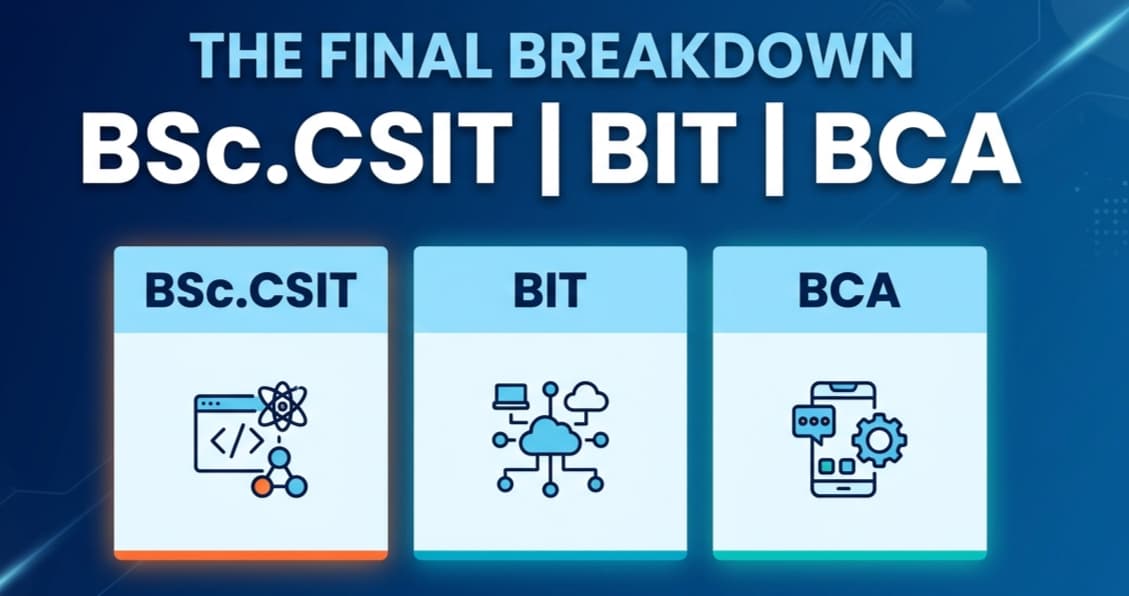
If you just finished your +2 or A-Levels and are looking to break into Nepal’s booming IT sector, you are likely staring at three distinct sets of alphabet soup: BSc.CSIT, BIT, and BCA.
Every college brochure you read will promise you the same exact thing: "World-class infrastructure, 100% placement, and an industry-ready tech career." But as anyone browsing student forums knows, the reality on the ground across various campuses in Kathmandu, Pokhara, and Chitwan can look very different.
Choosing the wrong degree can trap you in a 4-year cycle of outdated theoretical syllabus or deep mathematical proofs when all you wanted to do was build software apps. Let’s strip away the marketing jargon and analyze how these three popular undergraduate IT courses actually stack up under Tribhuvan University (TU), Kathmandu University (KU), Purbanchal University (PU), and Pokhara University (Pokhara Uni).
The Core Identity: What Are You Actually Paying For?
Before looking at the entrance exams and fee structures, you need to understand the fundamental philosophy behind how each course is designed.
[BSc.CSIT] ─── Deep Computer Science Theory & Mathematics (The "Why")
[BIT]      ─── Core Tech Stack Infrastructure & Modern Networking (The "How")
[BCA]      ─── Applied Software Construction & Business Tools (The "What")
1. BSc.CSIT (Bachelor of Science in Computer Science and Information Technology)
The Philosophy: This is a hardcore Computer Science (CS) degree modeled after international university standards. It focuses deeply on the computation theory behind how computers work.
The Experience: You won’t just learn how to code in Java or Python; you will study how compilers interpret that code, how complex algorithms are optimized, and the discrete mathematics that power system architecture.
The Catch: It is heavily theory-intensive and demands rigorous mathematical capability.
Kathmandu Model College
2. BIT (Bachelor of Information Technology)
The Philosophy: A pragmatic, fast-paced blend of modern technology applications, systems infrastructure, and basic organizational management.
The Experience: BIT cuts out the heavy theoretical proofs of computer science (like Automata theory or advanced physics) and replaces them with immediate, practical tech stacks—web application development, system administration, cloud concepts, and enterprise networking.
The Catch: Curriculum depth can vary wildly depending on whether you choose a TU-affiliated program, a Pokhara University program, or a foreign university-affiliated college.
3. BCA (Bachelor of Computer Applications)
The Philosophy: An application-first, accessible gateway into software construction hosted primarily under the humanities or computer faculties.
The Experience: BCA assumes you want to build mobile apps, manage localized database management systems (DBMS), design interfaces, and deploy web solutions without drowning in engineering-level math.
The Catch: Because it is highly accessible, the entry barrier is lower. You must proactively build a personal portfolio outside of class to compete effectively with CSIT graduates for high-end engineering roles.
Head-to-Head Comparison Table
Feature Matrix | BSc.CSIT | BIT | BCA |
|---|---|---|---|
Primary Stream | Science / Technology | Tech & Infrastructure | Humanities / Management |
Math Intensity | Very High (Calculus, Statistics, Discrete Math) | Moderate (Applied Math, Basic Statistics) | Light (Basic Math, Business Mathematics) |
Focus Area | Algorithms, OS Architecture, AI Foundations | Networking, Cloud, Web/App Implementation | App Development, Database Design, UI Tools |
Academic Punctuality | Generally strict & predictable board timelines | Varies by University board structure | Can face regional/faculty scheduling delays |
Portfolio Timeline | Heavy project work usually starts late (3rd/4th Year) | Continuous projects and lab cycles from Mid-Semesters | Early project focus, emphasizing practical portfolios |
Eligibility and the Entrance Exam Reality Check (2026 Rules)
This is where your choices might instantly narrow down based on your high school background.
BSc.CSIT Eligibility
Background: Only +2 Science graduates (or equivalent I.Sc / A-Level / 3-year CTEVT Engineering Diploma) are eligible.
Academic Grades: You must have studied Physics and Mathematics (100 marks each) in +2, securing a minimum of a 'C' grade in every individual subject.
The Entrance Block: You MUST clear the TU Institute of Science and Technology (IOST) entrance exam. It is a highly competitive, 2-hour multiple-choice question (MCQ) format covering Mathematics (25), Physics (25), Chemistry (25), English (15), and General IT (10). There is no negative marking, but you need a minimum score of 35 to qualify, while top Kathmandu colleges require a score above 50 to clear the merit cutoff.
BIT Eligibility
Background: Highly flexible. While some specialized university boards prefer a science background, many BIT paths accept students from both Science and Management (+2 Computer Science/Business Math) streams.
Academic Grades: Usually requires a minimum GPA or equivalent second-division marks depending on the specific board (TU, PU, or foreign universities).
BCA Eligibility
Background: Completely democratic. Open to all streams—Science, Management, and Humanities alike.
Academic Grades: Historically required a minimum D+ grade in each subject of Grade 11 and 12, making it accessible if you didn't focus on raw science tracks in high school.
The Entrance Block: Must clear the Faculty of Humanities and Social Sciences (FOHSS) entrance criteria, which is far less intensive on raw engineering sciences than the CSIT framework.
Syllabus Deep Dive: What Will You Actually Learn?
To give you a real sense of what your weekly lecture routine will look like over the next four years, let's dissect the core milestones embedded within their respective syllabi.
The BSc.CSIT Syllabus Path
Expect a heavy, structured academic journey consisting of 126 credit hours. Your initial years are dedicated to foundational computational engineering before diving into modern specializations.
Year 1 & 2 (Foundations): Digital Logic, Discrete Structures, Linear Algebra, Object-Oriented Programming (C++/Java), Data Structures and Algorithms (DSA), and Microprocessors.
Year 3 & 4 (Advanced Depth): Design and Analysis of Algorithms (DAA), Compiler Design, Cryptography, Simulation and Modeling, Advanced Java Programming, Artificial Intelligence, and machine learning electives.
The BIT Syllabus Path
Designed for rapid technological deployment, the focus shifts away from pure mathematical derivations toward keeping systems operational and securely deployed.
Core Core Modules: Web Technologies (HTML, CSS, JavaScript framework integration), System Administration, Network and Cyber Security, Cloud Computing Architecture, E-Commerce Infrastructure, and IT Project Management.
The BCA Syllabus Path
Crafted around the creation of interactive, client-facing business applications. It mixes core logic with administrative fundamentals.
Core Core Modules: Visual Programming, Web Development frameworks, Mobile Application Architecture, Database Management Systems, Systems Analysis and Design (SAD), Management Information Systems (MIS), and basic business accounting.
Career Tracks & Salary Outcomes in Nepal's Tech Industry
While any developer will tell you that your skills matter more than your certificate, specific degrees naturally open distinct career doors faster straight after graduation.
[BSc.CSIT Graduates] ──> Data Scientist, Backend Engineer, AI/ML Researcher, System Architect
[BIT Graduates]      ──> DevOps Engineer, Cloud Engineer, Network Admin, Cyber Analyst
[BCA Graduates]      ──> UI/UX Designer, Frontend Developer, Mobile App Developer, Freelancer
Market Salaries (Fresh Graduate Estimates)
High-End Specialized Tech (AI, Backend Architecture, Compiler Systems): Typically draws a starting tier of NPR 35,000 to 60,000/month. BSc.CSIT graduates with clean algorithm structures often transition here rapidly.
Core Engineering & Application Development (Full Stack, Mobile Apps, Infrastructure): Typically starts around NPR 25,000 to 45,000/month. This is the prime playing field for agile BIT and BCA graduates who enter the market with a rich portfolio of built websites and client apps.
Final Verdict: Which One Should You Choose?
Let's make this simple. Cut through the noise and evaluate where you match:
Choose BSc.CSIT if: You genuinely enjoy mathematics, want to know how operating systems run internally, aim to enter complex sub-fields like Artificial Intelligence or Deep Data Science, and plan to pursue research or an MSc/PhD abroad later.
Choose BIT if: You want a modern, practical IT career, prefer building cloud networks and server pipelines over proving algorithmic theorems, and want to skip pure science topics like chemistry or hardware physics.
Choose BCA if: Your high school background wasn't in the pure science stream, you want a lighter math workload, you are a highly practical learner who wants to jump straight into building apps, and you are prepared to hustle independently to build your tech skills.
📢 Before You Lock in Your Admission Form: Don't trust the official college prospectus blindly. What do the seniors actually say about the teachers, labs, and internal management?
Search for your target campus right here on collegereviewnepal.co to read 100% anonymous, unfiltered reviews written by real students currently studying there.
Already a student? Help the next batch make the right choice—search for your college and leave your honest review today.
Comments
Log in to leave a comment.